Time Dependent Roc Curve R . My goal was to evaluate my survival tree through area under curve (auc) in roc curve. Added by quilmes on sat, 05 mar 2022 06:44:06 +0200. ROC curves in the upper part of the figure the ROC curve of the merged from www.researchgate.net Using of the roc.plot () function. I particularly like the way the performance() function has you set up calculation of the curve by entering the true positive rate, tpr, and false positive rate, fpr, parameters.not only is this reassuringly transparent, it shows the flexibility to calculate nearly. This enables computation of inference procedures:
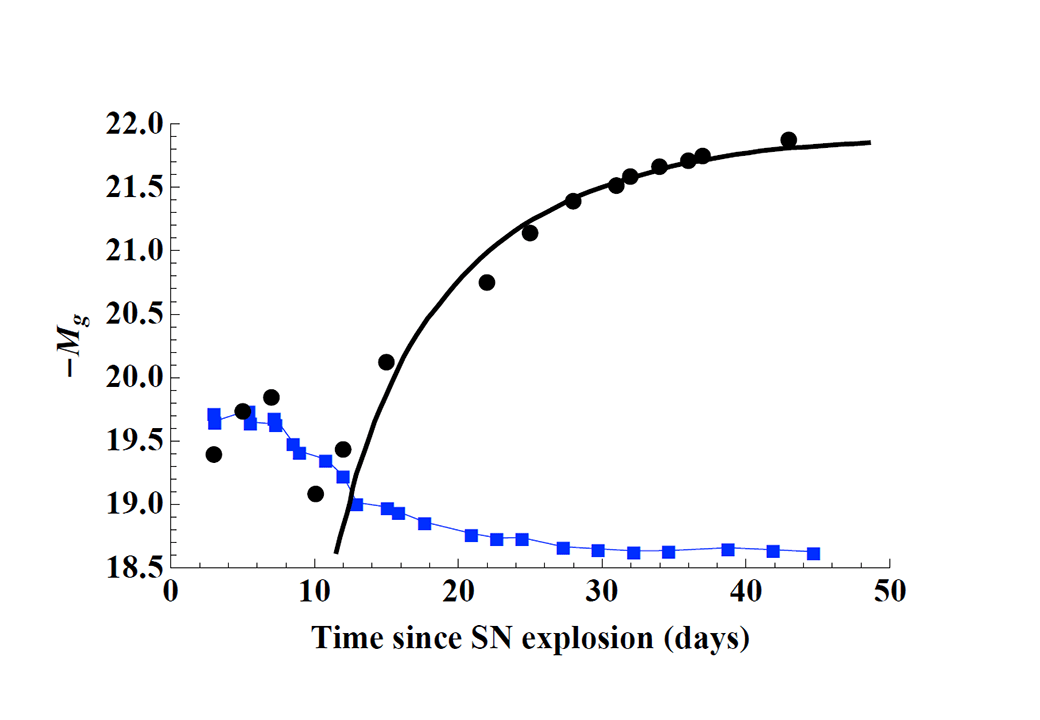
Type 1A Supernova Light Curve. Type ia supernova light curves. Two other type ia supernovae, 1991m and 1991t, were observed only at vvo.
QNP Light Curve Fits from www.quarknova.ca
The light curves among the different type i supernovae are much more homogeneous than the light curves among type ii supernovae. The shapes of the light curves of all three supernovae, including the spectroscopically peculiar sn 1991, are quite similar, and the combined light curve in v matches leibundgut's [ph.d. The most common are type ii supernovae, which are produced when massive stars die.
Type 1A Supernova, However, Are Di.
Two other type ia supernovae, 1991m and 1991t, were observed only at vvo. Light curves using phoenix in both lte and nlte. This tool was used in this article and this article on sn 1987a.
Introduction All Types Of Supernovaeare Important For The Role That They Play In Understandingstellar Evolution, Galactic.
1997) are compared to the template (m 15) method for the sample of nearby supernovae.the top diagram shows the magnitude corrections based on the light curve shape and the bottom graph displays the. Another key piece of information astronomers use to classify supernovae is their light curves. Comparison of the light curve parameters from different methods.
1998A) And The Stretch Corrections (Perlmutter Et Al.
The light curves for type ii supernovae are characterised by a much slower decline than type i, on the order of 0.05 magnitudes per day, excluding the plateau phase. Sn 1986g provides graphic confirmation of the existence of intrinsic differences in the optical light curves and spectroscopic properties of type ia supernovae. Type ia spectra and light curves (their rising and falling brightness over time) are all nearly alike, and they are bright enough to be seen at very great distances.
A Type 1A Supernova Is The Most Commonly Observed In Outer Space And Acts Like A Candle Light To Help Us Observe Distances Across The Deep Dark Unknown.
They are mostly the result of dying stars collapsing and exploding, and since those stars come in a range of sizes and types and masses, the resulting explosions vary accordingly. A different approach for putting the empirical relations on a firmer basis is to try. The conversion of hydrogen into helium at the core of a star releases energy in the form of photons, and this light pressure pushes against the force of gravity trying to pull the star in on itself.
It Illustrates The Results Of Careful Study Of Supernova Type Ia Light Curves Which Has Led To Two Approaches For Standardizing Those Curves.
The most common are type ii supernovae, which are produced when massive stars die. This catalogue is a rich tool for the systematic analysis of sne ia light curves and was derived using published light curve data described in chapter 3. Thesis, university of basel (1988)] template reasonably well.


Comments
Post a Comment